
It’s winter in northern Europe, and there’s no electricity. How can you dry your laundry? One of the best places of all is a laundry room in the servants’ quarters of a mansion house. A generous ceiling height means you can have frames for wet clothes and household linen in the warmest, dryest part of the room. The estate handyman would make them, and by the later 19th century he would probably add ropes and a pulley to raise and lower the rack. No need to climb on a chair to hang laundry.
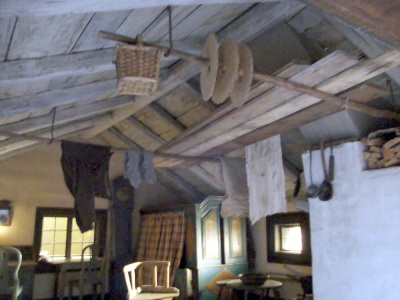
It was different in a small cottage. With life centred on one room there could be a lot hanging from the ceiling: foodstuffs needing a dry, vermin-free spot, baskets empty or full, medicinal and culinary herbs drying, as well as a steady stream of laundry and clothing soaked by bad weather.
One simple pole attached to roof timbers was better than nothing. Drying washing on frame airers by a fire is effective, but getting some of it up and out of the way is a relief in a small space.
Ceiling clothes pulleys used to be common in the UK, and they are still used in older houses where there is enough height in the room. In ordinary-sized houses they often used to be in the kitchen, so the fresh smell of newly-aired linen might be masked by a vague aroma of cooking. This is the only disadvantage I know of with ceiling drying.
Advantages are obvious. It’s simple. It’s cheap. It uses rising heat that’s wasted otherwise. It’s not much work spreading out the laundry and taking it down later. You can fix racks on lower ceilings if you don’t need the room when you’re drying things.
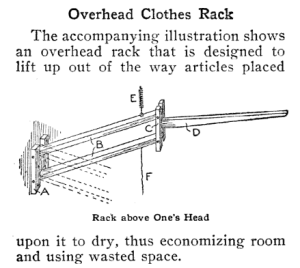
Although drying racks on the ceiling were not unknown in American homes of the early 1900s, they seemed to vanish later. But recently they have come back to the USA, perhaps for people interested in saving energy. You could make one yourself, but you can buy ready-made ones with metal bits imported from the UK, plus US timber. The racks cost a bit more than in Europe, but they are still a practical, environment-friendly way of drying and airing for some people – and money-saving over time.
Clothes Driers vary from the hemp clothes-line, taken down after each drying, copper wires, stretched taut and left out permanently, to revolving driers mounted either on a post in the yard or on a projecting arm from a porch or window. Indoor driers vary from the clothes horse to a rack which is pulled by pulley to the ceiling (very convenient for limited spaces, costing about $5.00).
From: Laundering, by Lydia Ray Balderston, Philadelphia, 1914 & 1923)
An easy way to have your own ceiling clothes airer
The traditional UK pulley clothes dryer is now available in the USA from Amazon.com. There’s a range of sizes and fittings come in different colours. Click the one on the left if you’re in the US. The one on the right comes from Amazon UK.
USA: 


Photos
Photos on this page by HomeThingsPast.
More picture info here.


Very nice post, i for sure enjoy the blog, keep on it.
LikeLike
my mother, age 91, still uses one of these racks and so do I. both of us live on the West Coast of Canada with, obviously, English heritage. She never has owned an electric dryer. I use my dryer about once a year!
LikeLike
I don’t know if it’s just me or if everybody else experiencing problems with your
blog. It appears like some of the text on your content are running off the screen. Can somebody else please provide feedback and let me know if this
is happening to them as well? This might be a issue with my internet browser because I’ve had this happen before.
Cheers
LikeLike
I must say it was hard to find your page in search results.
You write awesome posts but you should rank your page higher in search engines.
If you don’t know how to do it search on youtube: how to rank a
website Marcel’s way
LikeLike